Two Player Game: 1v1 Challenge
- 4.6
- Rating
- 10.00M
- Installs
- Free
- Price
 Analysis by App-foxy
Some mobile games are built for long sessions, while Two Player Game: 1v1 Challenge is much more comfortable as a quick social test. I found its appeal almost immediately: it turns one phone into a small competitive arena for two people, making it easy to start a match when you are sitting beside a friend, waiting somewhere, or looking for a short distraction. It belongs to the arcade side of mobile gaming, and that matters because the experience is focused on immediate reactions rather than a large world, a long story, or a complicated progression system.
The central idea is simple, but simplicity is not the same as weakness here. The game is made by stick hunter and is free to install, with optional in-app purchases priced at $2.99 per item. Its Everyone age rating also makes the concept broadly approachable. I would not describe it as a replacement for a deeper multiplayer game, though. I see it more as a pocket collection of competitive moments: something you open when another person is already there and both of you want to play without preparation.
What keeps the first week interesting
During the first few sessions, the strongest feature is the lack of ceremony. You do not need to explain a complicated control scheme before handing the phone to someone else. The two-player format gives the game an obvious purpose, and the local setting changes the feeling completely compared with playing against an unseen online opponent. A friend can react to what happened immediately, complain about a close loss, and ask for another round without leaving the room.
You May Also Like

 Blood Strike: 2.5 Anniversary
Blood Strike’s Loadouts Turn Every Drop Into a Tactical Gamble
A close look at Blood Strike’s custom loadouts: how fast access to signature weapons reshapes its battle royale rhythm, rewards preparation, and narrows the gap between fights.

 Pandora - Music & Podcasts
Pandora’s Music Is Easy to Start, but Harder to Recover
Pandora’s strength is its low-effort path from a seed to a station. Its weak spot is how much confidence it asks you to place in connection, setup, and quiet recovery.

 8 Ball Pool
 Is Built on Rivalries, Rematches, and Routine
A close look at the rivalries, rematches, shared routines, and unanswered safety questions that turn a quick pool match into a persistent mobile community.

 Samsung Music
’s Quiet Strength Is Playing What You Already Own
Its reach comes less from spectacle than from dependable access to a personal library. That simplicity is both the app’s strongest retention engine and its ceiling.

 AccuWeather: Weather Radar
AccuWeather Review: A Quick, Clear Forecast for Everyday Decisions
For everyday plans, the best forecast is the one you can understand quickly. AccuWeather makes rain timing, radar, and local conditions easy to act on, with a few trade-offs.

 Hill Climb Racing
Why Hill Climb Racing Still Turns Crashes Into One More Run
A tiny car, a bumpy hill and one more upgrade: Hill Climb Racing keeps resurfacing because its simple chaos makes every near-miss feel personal.
More From Our News Desk



That makes it particularly useful in everyday situations where a full game would be excessive. I can imagine using it during a short break with a colleague, passing the phone around at a casual gathering, or playing a few rounds with a family member while waiting for food. The best sessions are not planned entertainment; they happen because the game is already installed and the other player is within reach.
The first-week appeal also comes from discovering which challenges suit each person. In a two-player arcade game, a small difference in reaction speed or familiarity can shape the whole match. One player may enjoy testing reflexes, while another prefers learning the rhythm of a particular challenge. That variety can make the opening sessions feel more substantial than the short store description suggests, even though the overall concept remains deliberately lightweight.
I would still set expectations correctly. This is not the kind of game I would choose when I want a solo campaign, character development, or a carefully structured competitive ladder. Its strength is the immediate contest, not a large amount of content surrounding that contest. If you are downloading it alone and expecting a deep single-player experience, the first impression may be less convincing.
Why local competition feels different
Playing on one device creates a useful kind of pressure. When two people are looking at the same screen, every mistake is visible, and there is no need for voice chat or matchmaking. That removes several barriers found in online alternatives: no waiting for a suitable opponent, no dependence on another person being connected, and no need to coordinate schedules across different devices.
The trade-off is physical. Two people need to hold or share a single phone comfortably, and that is not ideal for every setting. A larger screen would make the experience easier to follow, while a smaller phone can make the shared layout feel cramped. I would recommend trying a stable surface or agreeing in advance how the device will be held, because an awkward grip can become more frustrating than the challenge itself.
There is also a social advantage to the short format. Losing does not feel as costly when another attempt is only a moment away. That encourages playful rematches rather than the tension that can build around a long online match. For younger players and families, the Everyone rating makes the game easier to consider, although the competitive mood can still become intense if players take every round seriously.
How it compares with familiar arcade choices
Compared with a traditional solo arcade game, this one gives the other person an active role instead of making them watch. That is its clearest reason to exist. Compared with online multiplayer games, it sacrifices scale and persistent competition in exchange for convenience and face-to-face interaction. I would choose it over a standard endless runner when I have a nearby opponent, but I would choose a larger online game when I want matchmaking, progression, or a community that continues after the phone is put away.
It also differs from board-game apps in tone. A digital board game usually asks players to think through turns, rules, and longer decisions. This experience is better suited to people who want an immediate arcade contest with little explanation. That makes it easier to introduce, but it also means the game has fewer ways to reward patience or long-term planning.
One practical tip is to treat each session as a small event rather than trying to grind through it. Decide on a short series of rounds, switch who starts, and stop while both players still want another match. That approach protects the game’s best quality: it stays a convenient source of quick rivalry instead of becoming a repetitive obligation.
What remains useful after the novelty fades
The first week tells you whether the basic format works for your household or friend group. The following weeks answer a harder question: does anyone still reach for it without being reminded? In my experience, the answer depends less on the game itself than on whether you regularly have a second player nearby. Its recurring value is naturally social, so it cannot create the same habit as a solo game that offers daily goals or a personal score to improve.
For a pair of friends who enjoy friendly competition, the replay value can remain healthy. Small differences in timing make rematches worthwhile, especially when neither player is consistently dominant. The game can become a familiar fallback for a few minutes of entertainment. It works well as a “one more round” activity, particularly when more demanding games would take too long to load or explain.
For someone who mostly plays alone, the long-term value is much weaker. The two-player identity is not a minor extra; it is the reason to keep the app installed. I would skip it if my usual gaming routine involves commuting alone, playing with headphones, or looking for progress that continues across sessions. A solo arcade title would probably provide a more dependable habit in that situation.
The public response suggests that the concept has reached a substantial audience: it holds a 4.4 average from around 68 thousand ratings and has passed 10 million installs. Those figures do not change the personal test, however. Popularity can show that the format is easy to understand, but it cannot guarantee that your own group will keep returning after the initial curiosity. The real measure is whether the same two people still want rematches after they have learned the basic rhythm.
Building a repeatable play routine
If I wanted to keep this game in regular rotation, I would attach it to a specific situation instead of opening it randomly. A short evening challenge between siblings, a quick match before a movie, or a recurring break-time contest gives the app a reason to return. Without that context, it may disappear among other games because the experience does not demand daily attention.
Another useful habit is to let players alternate control of the phone between rounds. This sounds minor, but it prevents one person from becoming the permanent holder and keeps the competition feeling fair. It also makes the game more suitable for mixed ages, since a less experienced player can receive a calmer introduction rather than being thrown into a fast contest immediately.
I would also avoid measuring its value by total playtime. A game like this can earn its place through ten enjoyable minutes rather than several uninterrupted hours. Its success is not that it occupies an entire afternoon; it is that it can rescue a dull gap without requiring planning. That is a smaller promise, but it is more realistic and easier to maintain.
What may cause fatigue
The main source of fatigue is repetition without a changing social context. Once players understand the challenges and discover their usual strengths, another match can begin to feel predictable. The first few victories are exciting because everyone is learning. Later, the same matchup may lose energy if one person wins too often or if both players stop experimenting.
There is a simple way to reduce that problem: change opponents, change the length of a session, and stop using the game as the only shared activity. It works best alongside conversation or another casual plan. If you expect it to provide a fresh surprise every time you open it, the limitations of a focused arcade game will become obvious sooner.
Another possible friction point is the shared-screen arrangement. A two-player game on one phone is convenient, but it is not as comfortable as separate controllers or separate displays. Players may need to adjust their seating, keep the device steady, and pay attention to whose turn or control area is active. These are manageable issues, yet they matter more during long sessions than during a quick challenge.
The optional purchases are another consideration. The game is free, which makes trying it low-risk, but items priced at $2.99 each can change how comfortable someone feels about continued use. I would first decide whether the free experience already supports the kind of short local play I want. Paying only makes sense if an optional item genuinely improves that routine; it should not be treated as a requirement for discovering whether the core idea suits you.
Maintenance and everyday practicality
From a maintenance point of view, the game is relatively easy to keep around because its purpose is clear. I do not need to organize a profile, build a collection, or follow a long sequence of tasks before a friend can play. The current version is 1.9.1, and it supports devices running Android 7.0 or later, which gives it a broad place on many older Android phones as well as newer ones.
That compatibility is useful when the phone being used is not the newest device in the room. A family may have one shared handset or an older spare phone, and a lightweight arcade game is more practical there than a demanding modern release. Still, I would not assume that every screen size will feel equally comfortable for two people. The best experience depends on whether both players can see and reach their parts of the display without constantly repositioning the device.
The app is also easy to justify as an occasional installation. Because it is free to download and rated for Everyone, it can sit on a household device until a suitable moment appears. The downside is that an app with a narrow social purpose can become forgotten if the people around you do not play together often. In that case, removing it and reinstalling it later may make more sense than keeping it permanently in active rotation.
One maintenance habit I recommend is checking the game’s fit after a few weeks rather than assuming that frequent installation equals frequent use. Ask whether it has actually helped create enjoyable shared moments. If it has, keep it available. If it has only been opened once because nobody wanted to share a phone, another arcade option designed for solo play will serve you better.
Who should keep it installed?
Two Player Game: 1v1 Challenge earns its space most convincingly in homes, classrooms during appropriate free time, waiting areas, and friend groups where two people regularly share a device. It is especially suitable for players who want fast competition without online accounts, a long tutorial, or a commitment to a full-length match. The app’s age rating and straightforward arcade identity also make it easier to introduce to a broad group.
I would recommend it to someone who enjoys playful rivalry more than personal progression. If you like comparing reactions, demanding a rematch, and laughing at a mistake that happened seconds ago, the format has a clear charm. It is also a good emergency choice when two people are bored but do not want to search for a game, connect controllers, or wait for a multiplayer lobby.
I would be more cautious with competitive players who need rankings, detailed statistics, or a long-term achievement structure. The same applies to anyone who normally plays alone. The game’s convenience cannot compensate for the absence of a nearby partner, and no amount of novelty will turn a social two-player format into a satisfying solo routine for every user.
My long-term verdict
After the novelty fades, this game does not become a universal arcade recommendation, but it does remain useful for the right kind of player. Its lasting value comes from repeatable social situations rather than an ever-expanding system. If you have someone nearby who enjoys short contests, it can stay installed as a dependable way to fill small gaps in the day. If you rarely play with another person, its strongest reason to exist is missing.
I appreciate that the game understands its own scale. It does not need to replace a console party game or a large online title. Its job is to make a shared phone feel like a quick competitive activity, and it succeeds when the session stays short, informal, and easy to restart. The trade-off is that repetition, an awkward shared screen, and optional purchases can become more noticeable when players try to stretch it beyond that role.
My recommendation is therefore conditional but positive: install it if local two-player arcade matches fit naturally into your routine, and judge it by the quality of those moments rather than by how many hours it can hold your attention. For a friend who always has a nearby rival, I would gladly suggest it. For a solo player seeking deep replayability, I would point toward a more substantial arcade alternative instead. In the right setting, though, this free game has enough immediate fun to earn a small, practical place on the phone.
FAQs for Two Player Game: 1v1 Challenge
01What is Two Player Game: 1v1 Challenge?
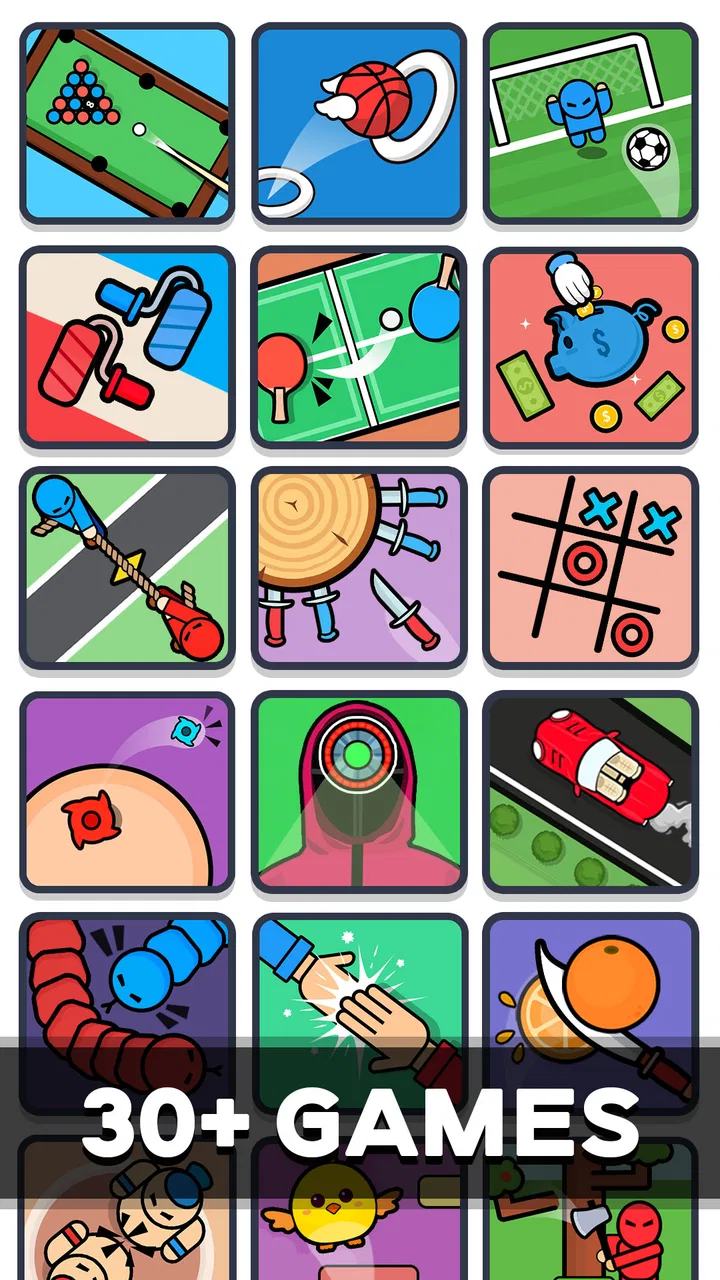
Two Player Game: 1v1 Challenge is a mobile app designed for direct competition between two players on the same device. It's packed with various mini-games that test skills, reflexes, and strategy. The app is available on both Android and iOS platforms, offering an engaging experience for friends and family.
02Can I play Two Player Game: 1v1 Challenge online with friends?
No, Two Player Game: 1v1 Challenge is specifically designed for offline play on the same device. It focuses on providing an interactive experience by allowing two players to engage in games directly, making it perfect for face-to-face competition.
03How many mini-games are available in Two Player Game: 1v1 Challenge?
The app features a variety of mini-games, each offering unique challenges and gameplay mechanics. Although the exact number may vary with updates, it generally includes a diverse selection to keep players entertained and ensure replayability. Check the app's latest update notes for the current list.
04Does Two Player Game: 1v1 Challenge require any in-app purchases?
Two Player Game: 1v1 Challenge is free to download and play, but it may offer optional in-app purchases. These purchases can enhance the gaming experience by unlocking additional content or removing ads. However, the core gameplay remains accessible without any purchases.
05Is Two Player Game: 1v1 Challenge suitable for all ages?
Yes, Two Player Game: 1v1 Challenge is designed to be family-friendly and suitable for players of all ages. The games emphasize fun and friendly competition without any inappropriate content, making it an excellent choice for children and adults alike.
Pros
- Engaging multiplayer mode
- Simple and intuitive controls
- Variety of mini-games
- Quick matchmaking
- Offline play available
Cons
- Advertisements can be intrusive
- Limited customization options
- Some games lack depth
- Occasional connectivity issues
- In-app purchases can be pricey

Two Player Game: 1v1 Challenge
Gallery